
AuDHD
AuDHD: autism and ADHD together.
What AuDHD means, how the two sides can pull against each other, and simple ways to support a brain that's both.
What is AuDHD?
AuDHD is a non-clinical, community-created term for someone who has both Autism Spectrum Disorder (ASD) and Attention-Deficit/Hyperactivity Disorder (ADHD). It isn't a separate diagnosis. It's a word the neurodivergent community uses to describe what it's like to live with both at the same time.
Autism and ADHD often show up together, and having both can feel very different from having just one.
Having autism and ADHD at the same time is like being cold and hot at the same time, in my opinion. If you are just hot, you can focus on fixing that and cooling down: take off your blanket, take off your socks, turn down the heat, take a log off the fire, and so on. If you are hot and cold, all of those solutions won't work. They will just make me colder.
So the difficult part, and the innovative area, will be discovering new methods and ways of working with neurodiverse people. In my opinion, we are all like unique snowflakes, and what works for me might be unhelpful for you, and vice versa.
A lot of healing is trial and error: finding what works for you as an individual, with the help of experienced people like doctors, therapists, nutritionists, social workers, life coaches and those working in Lifestyle Intervention, like us at ADHD & ME!
What the autism spectrum really looks like
Many people picture the autism spectrum as a straight line, with "high functioning" or mild autism at one end and "low functioning" or severe autism at the other. That isn't how it works.
The spectrum is more like a colour wheel. Each autistic person has their own mix of strengths and challenges across areas like sensory processing, emotion regulation, communication, social differences, routines, anxiety, repetitions, interests, executive functions, motor skills, information processing and perception. Someone can find one area really hard and another area easy, and that mix is different for everyone.
So, to use the example of what the autism spectrum is like, below, I'll share a bit of where I would land on that colour wheel. If the closest spot to the centre of the circle represents the lowest degree of that symptom, we will call it a one. The space furthest to the outide of the wheel would be feeling the symptom often, it will equate to a four. for the first category, sensory processing, I would say I have a moderate to severe reaction, so I would put myself at a 3 on the wheel, in the third yellow box from the inside circle. The next one is communication, where I would score high as I am comfortable with 2 way communication and can express my wants and needs. I would be a four, the furthest bright green spot on the outsiode of the wheel. So oyu can see they will not all be a 1 or a 3, they will scatter randomly which is why autism is so unique to each individual.
Autism spectrum
Not like this:
But more like this:
- Sensory processing
- Emotion regulation
- Communication
- Social differences
- Routines
- Anxiety
- Repetitions
- Interests
- Executive functions
- Motor skills
- Information processing
- Perception
The tug-of-war inside
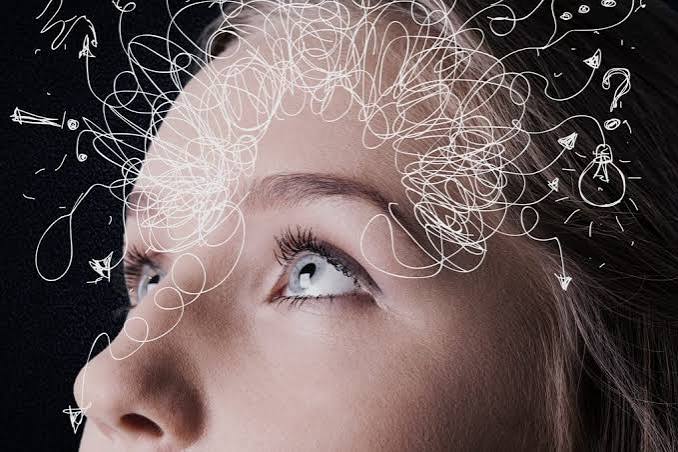
Many AuDHDers describe feeling pulled in two directions at once. The autistic side may crave routine, predictability and calm, while the ADHD side craves novelty, stimulation and change.
When I was younger, I used the analogy that being AuDHD is a bit like being a conjoined twin, where you are opposites: opposite likes, opposite styles and opposite ways of doing things. Opposite perceptions and tastes, and you often hate each other's style and choices for creative projects. It is weird, for sure, to argue with yourself.
I will be so proud of myself one moment, when I'm in creative autism mode and so happy with my work. Then my dopamine wears off, a few hours pass, and Emo Amanda comes to town. She looks at the work and tells me it's shit! It's boring! It's generic! I hate it. So I start over. Rinse and repeat. Sometimes my work looks like two people did it, because I am trying to combine both of my styles, but they don't match or go together, so it doesn't work.
Part of me wants my site to be bold, modern and artsy, using magentas, wild themes, and eccentric colours and formats. Autistic Amanda wants the ADHD & ME site to be pretty, with butterflies and rainbows, and to be more traditional and calm. You can see who won this battle! :)
- Wanting a set routine, then getting bored of it and struggling to stick to it.
- Needing quiet to feel okay, but also needing noise or movement to focus.
- Loving deep, detailed special interests that switch on and off without warning.
- Craving connection with people, then needing lots of alone time to recover.
- Being very organized in one area of life and completely overwhelmed in another.
AuDHD isn't just autism + ADHD
The two often pull in opposite directions.
Routine
Autism: Needs routine and predictability
ADHD: Craves novelty and change
AuDHD: Needs routine, then gets bored of it
Focus
Autism: Deep focus on special interests
ADHD: Focus that jumps around
AuDHD: Intense interests that switch on and off
Senses
Autism: Easily overwhelmed by noise and light
ADHD: Seeks stimulation and movement
AuDHD: Needs quiet AND stimulation, depending on the day
People
Autism: Finds social rules draining
ADHD: Talks fast, interrupts, forgets plans
AuDHD: Craves connection, then needs lots of alone time
Planning
Autism: Likes clear steps and plans
ADHD: Struggles to start and finish
AuDHD: Makes detailed plans, then can't follow them
In their own words
This story about a neurodivergent woman's mornings will hit home for many readers
"Mornings used to be complete torture and doom for me. I woke up with tears in my eyes, knowing how painful getting out of bed and getting ready was going to be. My eyes are burning and continue to run. I can't hold it in. 'I don't want to do this anymore!' I whisper, as I cry. My head hurts and my body aches; just walking is painful.
My head is so loud, it's like there are 12 people in there, and all of them are angry at me. A few are reminding me of all the stupid things I said by mistake over the last 20 years. A couple of them are singing nursery rhymes from my kindergarten class eons ago... 'There was an old lady who swallowed a spider, that wriggled and jiggled and tickled inside her...' I try to turn it off.
My stomach turns and my IBS kicks in. I can't even pick out my clothes, the pain is too strong, so I lie down and breathe deeply, repeating a positive mantra to focus on: 'All is good in my world.' If only this were true.
An hour and a half has passed, I have accomplished nothing and I feel like crap. I have 20 minutes to get dressed, get all my shit together and make the bus. I'm gonna be late again. It's not my fault and nobody understands; they just think I'm busy doing my hair or sleeping in. I wish! I get up at 4 am and I'm lucky if I even brush my hair."
“Autism makes me an extreme rule follower. When ADHD impulsivity comes into play, it makes me angry with myself because I’ve ‘broken a rule.’ Both can play into agoraphobia and social interaction; At any point, I am either trying to either blend into the wall or thinking about how abnormal I am even as I try to chat and sound normal.”
“Sometimes my traits are in conflict, like wanting to take my time and be perfect but not having the attention span to do so. My ADHD brain signs me up for more than my autistic brain can deliver at times and vice versa.”
Autism patterns in women
Autism often looks different in women and girls. Many of us want close friendships but find the unwritten social rules exhausting, have a rich vocabulary but struggle with back-and-forth small talk, have deep interests that look "typical" on the surface (like animals, books or people), and feel sounds, lights, textures or smells much more intensely than others.
Why it's often missed in women
Autism and ADHD can mask each other. ADHD impulsivity can hide autistic traits, and autistic structure can hide ADHD struggles. Add the years many women spend masking to fit in, and it's no surprise lots of us only find out we're AuDHD in adulthood, often after burnout.
Neurodivergent isn't just autism and ADHD
Neurodivergence covers many different brains, and lots of us have more than one thing going on at once.
- Autism
- ADHD
- Dyslexia
- Dyscalculia
- Dysgraphia
- Dyspraxia (DCD)
- Tourette's & tics
- Synesthesia
- Epilepsy
- OCD
- Anxiety disorders
- Sensory processing differences
Many of us have more than one.
Quiet doesn't mean okay
Many women spend their entire lives "masking": mimicking neurotypical social cues, suppressing stimming, forcing eye contact, or pushing through sensory overload just to get through the day.
Just because they aren't "disruptive" or showing classic external signs doesn't mean they aren't struggling. Believing their pain or fatigue is just "being dramatic" or "shy" invalidates their actual neurological reality.

What can help
- Flexible routines: a loose structure with room to switch things up.
- Sensory care: headphones, soft lighting, comfy clothes and planned quiet time.
- Body doubling, timers and visual reminders to get started on tasks.
- Planning recovery time after social events, work or busy days.
- Finding people who get it, so you can unmask and just be you.

You're not "too much"
Being AuDHD means your brain works in its own beautiful, complicated way. Our community and 1:1 Lifestyle Interventions are here to help you build a life that fits both sides of you.

References
Want to read more? These sources and others are on our Resources page.
- Mom on the Spectrum: Common autistic traits in women (momonthespectrum.life)
- Cleveland Clinic: ADHD symptoms, types and treatment (my.clevelandclinic.org)
Watch: AuDHD explained
A great short explainer on why an AuDHD brain can struggle to start, or stop, anything.
This page is general information from lived experience, not medical advice. Talk to your doctor about diagnosis and treatment.