
What is ADHD?
A Ferrari engine with bicycle brakes.
ADHD (Attention-Deficit/Hyperactivity Disorder) shows up differently for everyone. Here's where it comes from, how it affects attention, the four types and the most common signs.
What is ADHD in adult women?
The Cleveland Clinic says the easiest way to define ADHD in adult women is a lifelong neurodevelopmental difference in how the brain regulates attention, time, emotions, and motivation—one that often shows up internally rather than through obvious physical hyperactivity.
Because symptoms are frequently quieter or hidden behind coping habits, they are often missed or mistaken for stress, anxiety, or personal flaws. According to Cleveland Clinic, ADHD centers on executive dysfunction—struggles with the brain's management system—and begins in childhood, even if it is not recognized until adulthood.
"A Ferarri engine with bicycle breaks" Coined by ADHD specialist Dr. Edward Hallowell, this classic metaphor captures the physical and mental pace of ADHD. Remember the Tortoise and the Hare? Well, we are the Hare, go, go, go, and then we hit the wall and need a nap. We don’t pace ourselves. Yeah, I know slow and steady may win the race, and that’s okay! We aren’t necessarily staying in it until the end; we’re just interested in a quick start. So we may be quick out of the gates, take the early lead but then decide to join a more interesting new race.
Racing thoughts, mental restlessness, feeling "on edge," or overthinking are common in the adhd woman. Emotional sensitivity is also a huge part of adhd, and RSD can be difficult for many to manage. Rejection Sensitive Dysphoria (RSD) is an intense emotional and physical response to real or perceived rejection, criticism, or failure and it can take over the ability to rationalize. Though it is a common and deeply impairing feature of Attention Deficit Hyperactivity Disorder (ADHD), RSD is not currently listed as a formal, standalone diagnosis in the Diagnostic and Statistical Manual of Mental Disorders (DSM-5).
Hiding struggles behind perfectionism, people-pleasing, over-preparing, or working extra hours to appear put-together. This constant effort can cause deep exhaustion and low self-esteem, and leads women with adhd working almost twice as hard as their peers just to keep up.
Dr.Amen, ADHD Specialist and renowned researcher posts:
ADHD isn’t just about behavior - it’s visible in the brain.
When most people focus, blood flow increases in the prefrontal cortex—the part of the brain responsible for attention, planning, organization, impulse control, and follow-through. But in many people with ADHD, the opposite happens. As they try harder to concentrate, blood flow in the prefrontal cortex can actually decrease, making it even more difficult to stay focused and tune out distractions.
These images come from SPECT (Single Photon Emission Computed Tomography), a specialized brain imaging study that measures blood flow and activity in the brain. A healthy scan shows full, balanced activity, while this ADHD scan reveals decreased activity in the prefrontal cortex during a concentration task.
It’s important to remember that ADHD isn’t one-size-fits-all. This scan represents just 1 of the 7 brain patterns associated with ADHD, which is why personalized evaluation and treatment matter.
The prefrontal cortex of the ADHD brain develops more slowly, and it produces less dopamine and norepinephrine, which can cause difficulties in executive functioning, focus, and impulse control. You can keep the ADHD brain healthy through medication, therapy, and positive lifestyle changes.
Below, the Amen Clinics image shows the difference between a healthy brain SPECT scan and one of the brain patterns commonly seen in ADHD.
Is ADHD genetic?
Researchers are closer to determining the specific genes that make someone susceptible to ADHD. More than one gene likely leads to its development, which is why ADHD is thought to be "polygenic."
The exact cause of ADHD is not yet known; however, many recent studies support the idea that it’s caused by an imbalance of certain neurotransmitters. In simpler terms, the quantity of chemicals that send messages in the brains of people with ADHD is different than the amount of those same chemicals in the brains of people without ADHD. Dopamine and norepinephrine are two of the most affected neurotransmitters; dopamine is involved in movement and norepinephrine influences attention, emotions, sleep and learning.
The next time someone says it's all in your head tell them they're right and show them your brain scan. :D
"So, ADHD is definitely inherited through family. So, we call it heritable, meaning that it gets passed down through families and that within families or even within the population, most of the individual differences and ADHD traits and symptoms is due to genetic factors. But there's a difference between something that's heritable and something that's genetic. When we say the word genetic, we're talking about known genetic causes, like a single gene or a set of genes that are causing ADHD."
Possible risk factors include:
- Genetics
- Exposure to environmental risks (for example, lead) during pregnancy or at a young age
- Alcohol and tobacco use during pregnancy and other pregnancy-related factors
- Child health conditions, including head injuries
- Parental mental health and family environment
ADHD's many names: a very long identity crisis
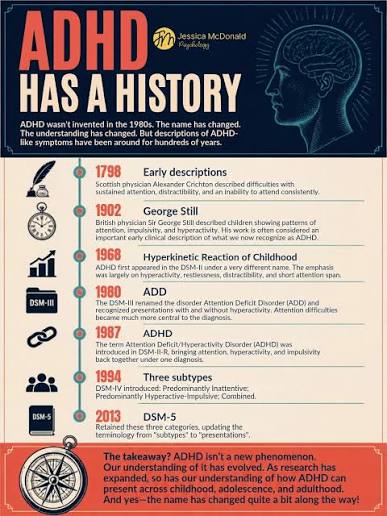
Attention-deficit/hyperactivity disorder (ADHD) has gone by many clinical and historical names since inattention and restlessness were first described in the late 1700s. Early labels focused on observed behaviour or suspected brain differences before settling on ADHD in 1987.
In other words, ADHD has rebranded more times than a pop star on her comeback tour. Here's the glow-up, era by era:

Early descriptions and medical terms (late 1700s–1950s)
1798
Mental Restlessness
Physician Alexander Crichton described traits matching modern inattention and restlessness.
So yes, women were losing their keys before keys were even cool.
1800s
Nervous child, hypermetamorphosis & friends
Textbooks used labels such as nervous child, hypermetamorphosis, mental instability, unstable nervous system, and simple hyperexcitability.
Hypermetamorphosis sounds less like a diagnosis and more like a butterfly with a caffeine habit. Honestly? Accurate.
1902
Defect of Moral Control
Sir George Frederic Still described impulsive, restless children using this early framing.
Ouch. Imagine getting that on your report card.
1920s–1930s
Postencephalitic Behavior Disorder & Hyperkinetic Disease
Clinicians compared similar symptoms to those seen after encephalitis, and researchers such as Kramer and Pollnow (1932) used terms like hyperkinetic disease.
Basically: "She can't sit still, let's give it a very long name."
1940s–1960s
Minimal Brain Damage / Minimal Brain Dysfunction
Practitioners inferred subtle brain damage or dysfunction from behavioural symptoms, though minimal brain dysfunction later fell out of favor for being too broad.
Our brains aren't damaged, thank you very much. They just have forty tabs open.
Diagnostic manuals and modern names (1968–present)
1968
Hyperkinetic Reaction of Childhood
Introduced in the DSM-II, focusing on overactivity, restlessness, and short attention span in children.
Spoiler: it doesn't magically disappear at 18. Many of us just learned to bounce our leg under the desk instead.
1980
Attention Deficit Disorder (ADD)
Introduced in the DSM-III with subtypes with or without hyperactivity (ADD+H and ADD-H), formally recognizing inattention.
Finally, the quiet daydreamers staring out the window got a mention!
1987
Attention-Deficit/Hyperactivity Disorder (ADHD)
Adopted in the DSM-III-R, combining inattention, hyperactivity, and impulsivity into one diagnosis.
One name to rule them all, and the one that finally stuck.
1990
Simple Disorder of Activity and Attention
Used in the ICD-10.
"Simple." Sure. Tell that to anyone who has tried to find their phone while holding it.
1994 / 2000 / 2013
ADHD presentations
The DSM-IV and later DSM-5 (which classified ADHD as a neurodevelopmental disorder) organized the diagnosis into presentations, commonly referred to as combined, predominantly inattentive, and predominantly hyperactive-impulsive.
Pick your flavour: daydreamer, whirlwind, or the deluxe combo platter.
How the ADHD brain handles attention
Scientists are still learning how ADHD affects the brain, but here's what we know so far. In ADHD, the frontal lobe is wired in a way that makes directed attention harder. Directed attention is what you use to focus on something that doesn't naturally interest you.
We lean on directed attention to plan, juggle tasks and solve problems. These skills are called executive functions. Using them takes real effort for anyone, especially when something more interesting is competing for your attention.
With ADHD, it takes even more energy. So after a long day at work or looking after everyone else, you might find yourself frozen in front of something that looks easy, like answering one email or putting the laundry away. It isn't laziness. The attention that "simple" task needs just isn't left in the tank.
The flip side? Women with ADHD are often better than most at automatic attention, the kind that switches on when something truly grabs you. That's what powers hyperfocus: getting "in the zone" and staying there for hours. Many of us use it to get really good at a hobby, a creative project or a career we love.
The attention tank, end of the day
Directed attention
For things that don't grab you: emails, forms, laundry, dishes.
Running on empty after a long day
Automatic attention
For things you love: a creative project, a hobby, a great book.
Full, ready to hyperfocus
The four types of ADHD
There are four types of ADHD that healthcare providers diagnose in adults (and children):
The 4 Official Types (DSM-5 Presentations) are Innatentive, Hyperactive-Impulsive, Combined and Unspecified Adhd which I had not heard of until recently.
What is Unspecified ADHD? In the DSM-5, Unspecified Attention-Deficit/Hyperactivity Disorder is an official diagnostic category used when ADHD symptoms cause clear, significant distress or impairment in daily life, but do not meet the full criteria for one of the three standard presentations. Sometimes, an “other specified” diagnosis will be revised later if the child’s symptoms evolve to better match a specific diagnosis.
Same treatment options: People diagnosed with Unspecified or Other Specified ADHD generally qualify for the same accommodations, behavioral therapy, and medication options
- Inattentive ADHD: This involves difficulty focusing, finishing tasks and staying organized. With this type, you have few or no hyperactivity symptoms.
- Hyperactive-impulsive ADHD: This involves difficulty sitting still or having “quiet time.” You have excess energy and are extremely talkative. You may also interrupt others and act without thinking it through first. You may show less obvious trouble with paying attention.
- Combined presentation: This is the most common type of ADHD, and it’s what most people associate with the condition. You have many inattentive symptoms and hyperactive-impulsive symptoms.
- Unspecified presentation: This is when you have severe symptoms that interfere with daily life, but your symptoms don’t meet the official criteria for the types listed above. In this case, providers assign “unspecified ADHD” as the diagnosis.
Inattention symptoms
I really struggle with inattention and putting off tasks. Not intentionally; I just can't do it until it's due, which is typical for the ADHD brain, so don't blame yourself. When something is due the next day, high pressure and fear of consequences suddenly trigger the brain's reward and stress responses, creating the focus needed to push through. So basically, we can't complete things until we feel the pressure. No pressure, no brain. Lol.
I got straight A's pretty much, until high school - oh, except for gym class. I usually got C's in Physical Education, which is wild because I was very athletic and flexible. But my grade was more lack of participation. I didn't participate due to stomach aches a lot, and usually got bored and distracted during the snooze-fest sports, like baseball or volleyball. Too much standing around for me, so I practiced my skating spins and jumps. lol. My mom would always say, "how the heck do you even get a C in gym class??" I guess by practicing flying camel spins, instead of practicing my volleyball serve. haha. This is a prime example of the ADHD brain being forced into an environment that their brain cannot handle, and being graded on it. If I were graded strictly on the sports that interested my brain, and that I could actually do, I would have gotten A's for sure. Like Dr. Suess says, "If you judge a fish on its ability to climb a tree, it will spend its whole life thinking its stupid."
Then my brain and body took a little detour to ADHD land. Down the rabbit hole I went. My grades took a huge nosedive and it was impossible to study.
I used to try to work on my school assignments a week or so ahead of time, like everyone else did, but I could not do it. My brain will not cooperate. It refuses, like a stubborn toddler with its arms crossed: "No! I want ice cream!" And I end up giving up and eating, watching TV or getting ice cream. I can only rock an assignment if I do it last minute, and I always did a great job, I must say. I almost lost all my hair, and my mind, in the process, but you know, it's all part of the process.
I have always felt the burn of inattentive ADHD. Doctors say that with inattentive ADHD, the individual turns all of the negative aspects inward, instead of displaying them on the outside like you see in hyperactive ADHD.
It can look like a poor memory and constantly losing things. I found that putting my initial on my items, like my stapler, helps me keep track of what is mine and where it is. It might also be tied to my OCD, since I have been doing it since I was little.
I remember getting a bald Cabbage Patch Kid from my mom when I was around six. I took a thick black Sharpie and drew a big, fat "A" right on her head, not realizing it was permanent. It was a rough day for my executive function, and Mama was not too happy either!
Check out the traits below and see if any hit home.
There is Michael, below. My old Cabbage Patch Doll, except mine had mint green overalls. And a big, thick, black A on his head.
I would keel over if I saw one on Ebay, and it had a big A on it's head! ha!
- Putting off tasks that need focus for a long time, like paperwork, taxes or forms.
- Missing details or making seemingly careless mistakes at work or at home.
- Forgetting appointments, bills, birthdays or things you promised to do.
- Getting easily distracted by what's going on around you, or by your own thoughts.
- Struggling to organize your home, your inbox, your calendar or the steps of a project.
- Losing focus in meetings, long conversations or while reading.
- Losing things you need, like keys, your phone, glasses or important papers.
- Seeming distracted or like you're daydreaming when someone is talking directly to you.
- Starting tasks easily enough, then getting sidetracked and leaving them half-finished.
Hyperactivity symptoms
In women, hyperactivity is often more internal: a restless mind rather than climbing the walls.
For me, hyperactivity looked like my leg or foot vibrating at supersonic speeds without me even realizing it. My foot would shake so hard and so fast it was basically a blur—like a tiny, anxious motor running under the table. I finally kicked that habit a few years ago (pun fully intended), and let me tell you, it was hard. Plot twist: I recently discovered I had a hidden histamine intolerance that was secretly fueling my anxiety and turning my lower half into a jackhammer. Now that I’ve addressed it, I don't even get the urge to shake. The other day, just for science (and fun), I tried to manually bring back the rabid foot shake to see what it felt like. It felt so bizarre. What used to feel like a comforting little dance now felt like I was trying to vibrate myself into another dimension. How on earth did I keep that up for hours while functioning like a normal human? The sheer coordination and cardio required to maintain that pace is honestly impressive.
Looking back, I’m deeply grateful that my mind has finally slowed down and found its happy place outside of all that frantic, neurotic energy. As women, we get so used to carrying invisible tension in our bodies and calling it "normal," or having to white-knuckle our way through every single self-improvement habit. Nowadays we have so much more information, and palces like ADHD and ME to gain the educatiuon needed to heal, with support, advice and someone holding your hand if you need it, every step of the way.
I genuinely never thought I’d make it to this side of things, so if you’re currently in the trenches of your own healing journey, please hear me: it is possible. Your nervous system can learn a new rhythm. Keep putting in the work, give yourself grace, and know that I’m rooting for you and here to help however I can.
I also used to suffer from what I like to call "hyperactive foot-in-mouth syndrome"—a term I just invented for that exact moment your brain whispers, "Whatever you do, do NOT bring this up," and your mouth immediately takes that as a personal challenge.
It was game over every single time. I’d be mid-conversation, actively trying to steer clear of a topic, and my brain would just short-circuit and blurt out the exact thing I was trying to avoid. Zero filter, zero impulse control—just my mouth operating entirely without adult supervision because the thought was taking up too much real estate in my head. Honestly, it gave major Austin Powers energy: "Moley, moley, moley. Mole." Haha! Totally. Between the vibrating foot and the runaway mouth, I was a hot mess!
- Fidgeting, tapping, jiggling your leg or needing to move, especially in long meetings or at dinner.
- Finding it hard to sit through movies, appointments or anything that means staying still.
- A busy, racing mind that's hard to switch off, especially at bedtime.
- Difficulty waiting in lines, in traffic or for your turn to talk.
- Interrupting others or jumping into conversations before you lose the thought.
- Feeling always "on the go" or "driven by a motor", even when you're exhausted.
- Finishing other people's sentences or blurting things out.
- Talking more than you meant to, then replaying it later.

So many women put on a brave face and a big smile, even when they're in serious pain on the inside.
ADHD affects approximately 1.5 million Canadians overall, with current estimates suggesting roughly 1 in every 21 people live with the condition. Women with ADHD experience significantly higher rates of physical and mental health challenges, including higher reported rates of chronic pain, insomnia and anxiety, driven by the exhaustion of "masking" (compensating and hiding symptoms to appear functional). Add a full-time job and kids to that, and you have an emotional meltdown and burnout waiting to happen, without the right intervention.
Source: The Conversation
If you are having negative thoughts and need support, call or text the 988 crisis hotline, any time, day or night. Or call 911 for immediate emergency response and assistance.
“Losing your phone while literally holding it.”
How ADHD can show up in daily life
ADHD Intrusive Sleep: When Your Brain Hits the Snooze Button on Boredom
Ever wondered why a long road trip feels like a personal lullaby? I used to get hit by heavy eyelids on highways and endless dirt roads alike. My brain would clock out early, leaving me yawning like a hippo. Eventually, I retired from driving because ADHD complications made it too risky—and honestly, letting someone else navigate via Uber is way less stressful.
Meetings are no better. During a long status update, I fight yawns with theatrical facial gymnastics, aggressive nose breathing, and strategic thigh pinches. The second the meeting ends, I am magically wide awake again. That rapid off-and-on switch is classic intrusive sleep: it ambushes you when stimulation drops and vanishes the moment things get interesting.
ADHD brains run on interest, not obligation. If the stimulus isn't engaging, the brain practically packs a bag and heads out.
The Science Behind the Nod
According to electroencephalography (EEG) researcher Marian Sigurdson, Ph.D., brain tracings during these episodes show slower theta waves crashing into the faster alpha and beta waves of waking focus. Think of the student in the back row who suddenly slumps over mid-lecture. Rather than classic bedtime drowsiness, that can be a boredom-triggered drop in alertness.
Intrusive sleep is still an evolving area of study, much like many ways ADHD shows up in women, and it is not a formal clinical diagnosis.
Ways to fight ADHD Intrusive Sleep:
- in meetings, sit close to the front and give yourself a job like taking minutes or being in charge of slides
- take a break, just 5 minutes and take a walk, get a drink, splash water on your face
- I find going outside helps me a lot, getting some fresh air and sunshine. I go outside for every break.
- do something to get the blood pumping like 20 jumping jacks or push ups
- eat something sour, like Sour Keys and drink something ice cold
- eat a snack! Often times the brain has no energy because we forget to eat and hydrate
- change your position, sit on the floor, stand up, etc
Why the ADHD brain cannot FAKE THE FUNK...
An ADHD brain doesn’t suffer from a deficit of attention; it operates on an interest-based nervous system. Unlike neurotypical brains that can power through mundane tasks simply because they are important or tied to a paycheck, your brain will not engage without genuine intrigue. Even when the stakes are high, you fundamentally cannot "fake the funk." For women with ADHD—many of whom have spent years masking, overcompensating, and trying to fit into rigid, conventional molds—this neurological reality isn't a flaw.
If you are still trying to uncover what truly lights you up, take a breath. You are in good company. Navigating the path toward your natural gifts takes time, which is why so many people default to the safe, predictable route. Yet for an ADHD mind, a lucrative title without creative autonomy or intellectual stimulation is a fast track to burnout. Your brain craves inspiration, self-expression, and the freedom to hyperfocus on things that matter. Finding an outlet for that energy is deeply restorative.
One thing that saved my sanity was making a "dopamine menu"—a massive list of everything that actually lights my fire. Don’t filter yourself. Write down every random thing that sparks your curiosity, makes you lose track of time, or just makes you feel like a kid again bringing out your inner child to play. I find working with kids with disabilities, fulfills me in almost every way - the ony downfall is the slow pace can be very difficult for my brain. To combat that so I don't get complacent, I will do extensive research on medical or gentic conditions, or anything that can help me grow in my profession. Some nights I will spend 3 hours researching topics because I enjoy learning about the topic so much, and so I can be informed and updated within my profession. The world is ever-evolving, so if you aren't constantly learning, and upgrading your professional knowledge, you will become a cavewoman or caveman in your feild, giving outdated and improper advice. It's like going to a modern salon for a new haircut, and they give you a style from the 2000's...at this point you know they haven't been upgrading their skills or taking new courses for hair styling. Are you going to go back there? Or would you go to the salon with the most updated and talented staff?
If you’re fresh out of high school and feeling the pressure to have your entire life mapped out right now, take a breath. Give yourself permission to be a professional sampler. Volunteer, shadow someone for a day, or grab a low-stakes part-time gig just to test-drive a vibe. Honestly, one of my favorite life hacks is treating everyday errands like casual career interviews. Whenever I see someone doing a job that looks remotely interesting, I ask them about it. If I’m at the hospital getting an ECG and the tech’s job looks cool, I’ll ask what they actually do all day, what schooling it took, what the job market looks like, and what the absolute best and worst parts of the gig are. People love talking about themselves, and you get the real tea without wasting tuition money. Your brain-spark list might look totally random—and that’s the point. Maybe it includes: • Video editing or music production • Painting, sculpting, or architecture • Training animals or working in education • Politics, food, or cooking Outside of career hunting, falling down a YouTube rabbit hole to learn new skills—especially around mindfulness and gratitude—helped me bring a lot of peace and positivity into my chaotic brain.
Careers That Are Basically Kryptonite for the ADHD Brain
Not every job is built for a mind that runs on curiosity, urgency, and creative sparks. When a role relies on endless repetition, microscopic details, or sitting still in a low-stimulation loop, an ADHD brain doesn’t just get bored—it hits full-blown burnout. Here are the lines of work that tend to clash hardest with how we’re wired: • Data Entry & Clerical Work: Same task, different spreadsheet, zero dopamine. Your brain will check out spiritually long before the clock hits five. • Accounting, Bookkeeping & Auditing: Endless rules, tiny numbers, and zero room for creative detours make this a fast track to mental fatigue. • Proofreading & Quality Control: Hunting for microscopic typos for hours on end is pure torture when your brain is built for big-picture brilliance. • Call Center & Customer Support: Reading from a rigid script while handling constant interruptions and high-stress callers is an executive-function ambush. • Long-Haul Driving & Monitoring: Staring at an endless stretch of highway or a wall of security screens without novelty makes staying alert an uphill battle. • Rigid Admin & Desk Roles: Being chained to a chair, micromanaged, and buried under other people’s calendars drains your battery before you even get to the good stuff.
Please keep in mind that this content is for educational and peer-support purposes only and is not a substitute for professional medical advice. Always consult a qualified healthcare provider before making changes to your health or wellness routine.
At Work or School
- Often late to meetings or forgets appointments
- Miss deadlines or avoid tasks that require long focus
- Workspace is messy or full of clutter
- Find it hard to work in noisy or busy areas
- Daydream often or feel distracted
- Cannot keep track of small details
At Home
- Trouble finishing chores
- Dishes, laundry, or paperwork pile up
- Lose things like keys, bills, or phones
- Have trouble following daily routines
- Start tasks but do not finish them
In Relationships
- Forget birthdays or special events
- Say things without thinking and upset others
- Feel bad for not doing things they promised
- Feel emotional and lose their temper easily
- Try hard to please others, but feel like they fail
In Social Settings
- Talk too much or change topics quickly
- Miss social cues like facial expressions or tone
- Feel shy or unsure when meeting new people
- Worry about being judged or rejected
Emotion and Mood
- Strong feelings that are hard to control
- Mood swings or sudden tears
- Feel low or hopeless often
- Struggle with self-worth or confidence
- Feel anxious or nervous for no clear reason
“I make sure to eat so I don't get hangry. I turn into Satan's spawn when I'm hungry...”
Why making and keeping friends can be hard for many women with ADHD
Making and keeping friends with ADHD is often harder because core symptoms—like executive dysfunction, inattention, impulsivity, and emotional sensitivity—directly affect how relationships start and stay strong. Friendships rely on consistent follow-through, reading subtle cues, and managing everyday logistics, all of which can take extra effort with an ADHD brain.
Resources like Healthline and Psychology Today highlight that treating friendship as a learnable skill—paired with systems like reminders, low-pressure check-ins, and shared-interest activities—can make connecting much more manageable.
I often feel overwhelmed by friendships in my life. I have so much going on and on my plate already, and find it difficult to pay attention to my friends and keep the commitments I make - so I stop committing and just give up.
Over time, my friends rightfully become frustrated or feel like I just don't care about them, not understanding how hard it is for me to make plans, keep the plan, get ready and leave the house, without something going wrong in between.
But please know this: I care so deeply for every friend I've had over the years. I'm truly grateful to have shared my life with so many amazing, intelligent and kind women. You've shaped who I am, and I carry a piece of each of you with me. XO
What helps me
- Don't make plans. Lol! I never pre-plan anymore.
- I wait until I'm dressed, ready and in the mood, and then I'll text someone if I want to go out.
- I listen to music while I get ready. It always helps me get in the mood to go out. (See my Dopamine Hitlist!)
- I make sure to eat so I don't get hangry. I turn into Satan's spawn when I'm hungry...
- I always have snacks and a bottle of water on me.
What helps you keep plans?
Share your own trick with other women. Once it's approved, it goes up on our note wall.
Famous people with ADHD
You're in very good company. These well-known people have spoken about ADHD, amongst many more.
Simone Biles, Jerry Seinfeld, Jim Carrey and Michael Jordan. I mean, you couldn't pick a cooler group to be associated with, in my opinion. Speed, strength, agility, perseverance and never giving up are things these four have in common. No matter who or what stood in their way, they were going to end up where they were destined to be.
Typically, when neurodivergent folks find what lights their fire, they are on the fast track to success. They are also often innovators in their niche who reshape their field and how people see it, introducing new ideas, tools or systems. These four individuals conquered their fields, refused to give up on their dreams and pushed harder than any of us can imagine, but it was well worth it! The only difference between those who succeed and those who don't is that those who succeed never give up. ;)
Anyone ever heard of Steve Jobs? Steve Jobs began his career as a technician before building Apple. He started the operation from his bedroom and sold his car to fund the technology. Apple is now worth about $2.8 trillion, and Jobs was the co-founder, chairman and CEO of the company. At the time of his death, his net worth was $10.2 billion.
Steve Jobs was diagnosed with dyslexia as a child and struggled severely in school, eventually dropping out of college, arguing that mainstream education lacked practical application. Throughout his life, he remained an advocate for breaking away from conventional forms of learning and practice: "You can't connect the dots looking forward; you can only connect them looking backwards."




- Jerry Seinfeld
- Simone Biles
- Michael Phelps
- Sia
- Anthony Hopkins
- Elon Musk
- Ryan Gosling
- Channing Tatum
- will.i.am
- Jim Carrey
- Michael Jordan
- Adam Levine
- Justin Timberlake
Historical figures who were (suspected) neurodivergent
These figures lived long before diagnosis existed, but many historians and researchers believe they showed autistic, ADHD or dyslexic traits.
Because clinical terms like autism, ADHD and dyslexia were not established until the 20th century, historians and psychologists can only speculate about historical figures based on diaries, letters and eyewitness accounts. Several renowned scientists, artists, writers and leaders from history are widely believed to have been neurodivergent.
Some of those suspected to have been neurodivergent are Sir Isaac Newton, Mozart, Charles Darwin, Van Gogh, Edison, Tesla, Picasso, Lewis Carroll and so many others. Even Jim Henson was on the list!
I mean, talk about a list of incredible people to be part of!! Think about that whenever your ADHD makes you feel like giving up: all the people before you who fought their way to the top without meds or a diagnosis. Now that deserves a standing ovation! It takes a lot of strength and self-esteem to keep going and follow your passion when it feels like everyone is doubting you and everything is in your way.
Being an innovator and inventor is a common thread in our type. Neurodivergent inventors, including those with diagnosed conditions like autism, ADHD, dyslexia or dyspraxia, as well as historical figures retrospectively linked to these traits, have shaped science, engineering and technology through pattern recognition, visual thinking and unconventional problem-solving.
Notable inventors
- Temple Grandin: an autistic animal scientist and inventor known for designing livestock handling systems and a therapeutic "hug machine" squeeze box.
- Larissa Suzuki: an inventor with autism and ADHD who holds patents in artificial intelligence, authentication and machine learning.
- Ayla Hutchinson: an inventor with dyspraxia who patented a safer log-splitting tool (the Kindling Cracker).
- Shawn Brown: a dyslexic engineer and designer who won UK Young Engineer of the Year for building a solar-powered electric trike.
- Alan Turing: a foundational computing pioneer and codebreaker whose work shaped modern computer science and AI, often discussed in relation to neurodivergence.
- Henry Ford: associated with dyslexia and over 50 patents, he advanced moving assembly-line mass production.
- Bill Gates: associated with ADHD and early personal computing software and hardware innovations.
WALT DISNEY Another suspected historical figure, that may have had adhd was Walt Disney. Wow, I am in good company. Walt Disney, the creator of Mickey Mouse and the mastermind behind Disneyland, is suspected to have had ADHD. Known for his boundless energy and endless imagination, Disney also struggled with traditional schooling. Like many kids with ADHD, he had trouble paying attention in class and was often caught doodling instead of focusing on lessons. Though he may have struggled with executive function in structured settings, Disney’s creativity led him to build one of the most successful entertainment empires in history. It's hard to see Adhd as a negative after looking at this huge list of amazing talents and innovators!


- Albert Einstein
- Emily Dickinson
- Leonardo da Vinci
- Andy Warhol
- Vincent van Gogh
- John Lennon (suspected ADHD)
- Agatha Christie (suspected dyslexia)
Famous neurodivergent women
For a long time ADHD and autism were seen as "boy" conditions. These women have spoken openly about their brains and are changing that story.
Paris Hilton has spoken a lot about her traumatic past in a teen behaviour camp due to her ADHD symptoms taking control of her brain and her life, which leads to pain and lashing out. Check out her YouTube Channel or videos for more info! youtu.be/12Z58u9MRFU?si=Q6bI6WIN2vB4QoHi
Nelly Frutado, the singer-songwriter views ADHD as a "superpower" that fuels her creativity. “I always credit my ADHD because it can be so debilitating in your home life, but when you’re in your creative life, at work — for me — it’s amazing,” she told TODAY.com.
Furtado was formally diagnosed with inattentive ADHD as an adult. "Playing instruments six days a week as a kid kept me in check," she told Fault Magazine in 2023. She added: "The good news is I’m getting to know my brain really well. I love talking about it, so I’m hoping to share my experience with people and have conversations about it."
Singer Sia, seen below in the silly string hair, publicly revealed in May 2023 that she is on the autism spectrum after receiving a diagnosis later in life. She shared this during an appearance on Rob Has a Podcast while speaking with Survivor runner-up Carolyn Wiger, who discussed her own ADHD and addiction recovery.
Colombian singer Shakira is frequently listed in public neurodiversity and celebrity directories as having been diagnosed with ADHD during her elementary school years, primarily manifesting as hyperactivity.
- Sia (autistic)
- Simone Biles (ADHD)
- Temple Grandin (autistic)
- Greta Thunberg (autistic)
- Paris Hilton (ADHD)
- Solange Knowles (ADHD)
- Mel Robbins (ADHD)
- Lisa Ling (ADHD)
- Hannah Gadsby (autistic & ADHD)
- Daryl Hannah (autistic)
- Emily Dickinson (suspected autistic)
Want to read more?
This page draws on information from Cleveland Clinic, WebMD, ADDitude and The Conversation. You'll find every source and other trusted links on our Resources page.
Other resources used: medium.com/@BiogeniQ/adhd-demystified-by-science-11bb17f18529 sunshine-support.org/adhd-what-is-rejection-sensitive-dysphoria TotallyADD.com, CDC.com, Psychiatry.org,
Resources
Helpful videos on ADHD, focus and how ADHD shows up in women.
Mel Robbins has been my biggest guide and motivation for starting this group.
This page is general information from lived experience, not medical advice. Talk to your doctor about diagnosis and treatment.